Generative Engine Optimization (GEO): How to Make Your Brand Visible in ChatGPT, Gemini & Google AI
The New Era of Search Has Arrived
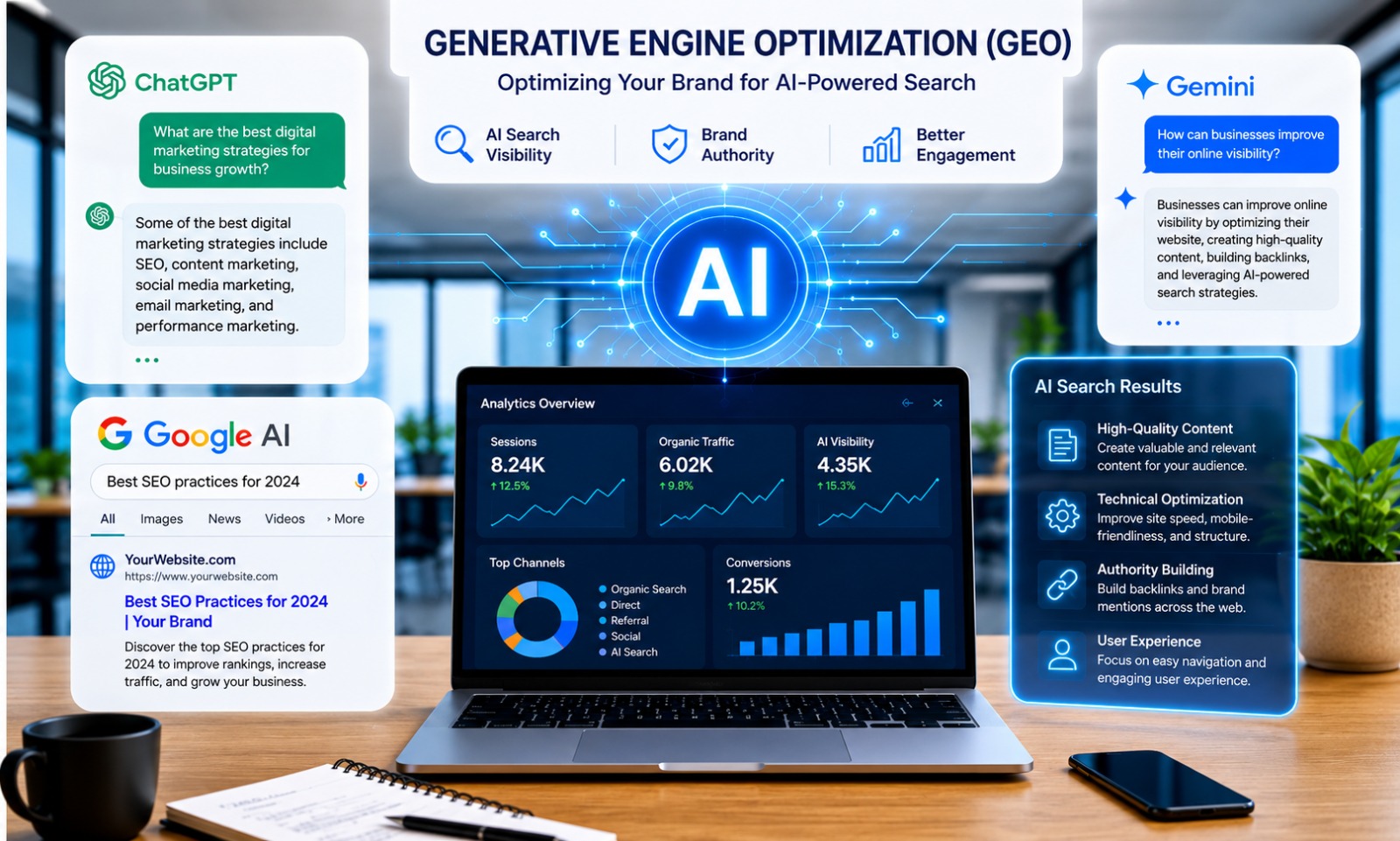
The digital search landscape is evolving rapidly. For years, businesses relied on Search Engine Optimization (SEO) to improve their rankings on Google and attract website visitors. However, the rise of Artificial Intelligence (AI) has changed the way people search for information. Today, users are increasingly turning to AI-powered platforms such as ChatGPT, Google AI, Gemini, Claude, Microsoft Copilot, and Perplexity AI to ask questions and receive direct, conversational answers instead of browsing multiple websites.
This shift has introduced a new digital marketing strategy known as Generative Engine Optimization (GEO). GEO focuses on optimizing content so that AI systems can understand, trust, and reference it while generating responses. Rather than simply appearing at the top of search engine results, businesses now aim to become reliable sources that AI assistants recommend to users.
As AI-generated search continues to grow, GEO is becoming an essential strategy for improving online visibility, building brand authority, and staying competitive in the future of digital marketing.
What is Generative Engine Optimization (GEO)?
Generative Engine Optimization (GEO) is the process of creating and optimizing digital content so that AI-powered search engines and conversational AI tools can easily understand, interpret, and include that content in their responses.
Unlike traditional
SEO,
which focuses mainly on improving rankings on search engine result pages (SERPs), GEO focuses on making content useful, trustworthy, and contextually relevant for AI models. AI systems analyze the quality, credibility, structure, and relevance of content before using it in their answers.
For example, when a user asks “What are the best project management tools for small businesses?”, an AI assistant may recommend brands whose websites provide clear, well-structured, and authoritative information. GEO increases the likelihood that a brand will be included in such recommendations.
Generative Engine Optimization (GEO) is the process of creating and optimizing digital content so that AI-powered search engines and conversational AI tools can easily understand, interpret, and include that content in their responses.
Unlike traditional SEO, which focuses mainly on improving rankings on search engine result pages (SERPs), GEO focuses on making content useful, trustworthy, and contextually relevant for AI models. AI systems analyze the quality, credibility, structure, and relevance of content before using it in their answers.
For example, when a user asks “What are the best project management tools for small businesses?”, an AI assistant may recommend brands whose websites provide clear, well-structured, and authoritative information. GEO increases the likelihood that a brand will be included in such recommendations.
GEO vs SEO
| SEO | GEO |
|---|---|
| Focuses on ranking webpages on search engines | Focuses on appearing in AI-generated answers |
| Uses keywords to improve rankings | Uses context, quality, and authority |
| Main goal is website traffic | Main goal is AI recommendations and brand visibility |
| Optimizes for Google’s ranking algorithm | Optimizes for AI models and Large Language Models (LLMs) |
| Success is measured by clicks and rankings | Success is measured by AI mentions, citations, and visibility |
Although GEO is different from SEO, the two strategies complement each other. A strong SEO foundation supports better GEO performance by ensuring your website is discoverable, technically optimized, and authoritative.
Why is GEO Important?
AI-powered search is changing how people discover information. Instead of opening several websites, users now expect AI assistants to provide complete answers instantly. This trend makes GEO increasingly important for businesses, marketers, publishers, and content creators who want to remain visible in an AI-first search ecosystem.
Benefits of GEO
- Improves brand visibility in AI-generated responses.
- Builds credibility and online authority.
- Increases the chances of being recommended by AI assistants.
- Helps businesses reach customers earlier in the decision-making process.
- Supports long-term digital marketing growth.
- Creates a competitive advantage as AI search adoption continues to increase.
Businesses that fail to optimize for AI may lose valuable visibility, even if they rank well in traditional search engine results.
How AI Selects Content
AI systems do not choose content randomly. Modern AI models evaluate multiple quality signals before referencing websites or brands in their responses. Creating content that satisfies these signals significantly increases the likelihood of being recommended.
Some of the most important ranking signals include:
- Accuracy and factual correctness
- Original and unique content
- Content that directly answers user questions
- Clear headings and logical content structure
- Website authority and trustworthiness
- Recent and regularly updated information
- Fast-loading, mobile-friendly websites with excellent user experience
Content that satisfies these factors has a much better chance of being referenced by AI platforms such as ChatGPT, Gemini, Google AI, Claude, Microsoft Copilot, and Perplexity AI.
Best GEO Strategies
1. Create Helpful and Original Content
AI systems prioritize content that genuinely helps users solve problems. Instead of writing articles solely for search engines, focus on creating content that answers real questions with practical, well-researched, and actionable information.
Original research, case studies, tutorials, expert opinions, and real-world examples significantly increase your credibility and improve your chances of being referenced by AI platforms.
2. Understand User Intent
Rather than targeting only short keywords, think about what users actually want to know. AI models are designed to understand intent rather than just matching keywords.
Example:
- Instead of: Digital Marketing
- Write: How Digital Marketing Helps Small Businesses Grow in 2026
AI performs better with content written around complete questions and detailed answers because it provides greater context.
3. Use Conversational Language
Most AI users type natural, conversational questions instead of short keyword phrases. Writing in a conversational tone helps AI understand and recommend your content more effectively.
Example:
- ❌ Best Laptop Student
- ✅ Which laptop is best for engineering students under ₹60,000?
Writing naturally improves GEO performance while also creating a better experience for readers.
4. Structure Content Properly
Well-organized content is easier for both readers and AI models to understand. Proper formatting improves readability and increases the likelihood of AI extracting relevant information.
Use:
- Clear headings (H2 & H3)
- Short paragraphs
- Bullet points
- Numbered lists
- Comparison tables
- FAQ sections
- Relevant internal and external links
A clean structure improves both user experience and AI comprehension.
5. Build Authority
Authority is one of the strongest signals used by AI systems when selecting trustworthy sources. Building authority takes time but significantly improves AI visibility.
You can improve authority by:
- Publishing expert-written content
- Citing reliable and authoritative sources
- Including industry statistics and research
- Keeping information accurate and regularly updated
- Earning backlinks from trusted websites
- Building a consistent brand presence across the web
6. Update Existing Content
AI platforms generally prefer fresh and relevant information. Reviewing and updating your existing content ensures that your website remains useful and trustworthy.
Regularly update:
- Statistics
- Product information
- Industry trends
- Screenshots
- Examples
- FAQs
Fresh content has a much higher chance of being selected by AI-generated search engines.
7. Improve Technical Performance
Technical optimization plays an important role in GEO. A fast, secure, and user-friendly website makes it easier for AI crawlers and search engines to understand your content.
Your website should:
- Load quickly
- Be mobile-friendly
- Use HTTPS security
- Have intuitive navigation
- Include Schema Markup
- Avoid broken links
- Maintain clean URL structures
These improvements make your website easier to crawl, index, and reference in AI-generated responses.
High-Value GEO Keywords
Using relevant keywords naturally throughout your content helps AI systems better understand your topic and improves contextual relevance. However, avoid keyword stuffing, as AI models prioritize quality over repetition.
Some valuable GEO keywords include:
- Generative Engine Optimization
- GEO
- AI Search Optimization
- ChatGPT SEO
- AI Visibility
- LLM Optimization
- AI Content Strategy
- AI Search Ranking
- Answer Engine Optimization (AEO)
- AI Marketing
- AI Content Optimization
Use these keywords naturally within headings, paragraphs, FAQs, and supporting content to maximize relevance without sacrificing readability.
Challenges of GEO
Although Generative Engine Optimization (GEO) offers significant opportunities for improving AI visibility, businesses should also be aware of the challenges involved. Since AI-powered search is still evolving, optimization strategies continue to change alongside advancements in Large Language Models (LLMs).
Some of the common challenges include:
- AI algorithms and ranking methodologies change frequently.
- Measuring AI visibility and citations is still limited compared to traditional SEO metrics.
- Producing consistently high-quality content requires time, expertise, and ongoing research.
- Competition is increasing as more businesses begin optimizing for AI search.
- Different AI platforms may evaluate and prioritize content differently.
Despite these challenges, businesses that invest in GEO today will be better positioned to benefit from the continued growth of AI-powered search.
Future of GEO
Experts believe that AI-powered search will continue to reshape how users discover information online. As conversational AI becomes the preferred method for finding answers, businesses will need to optimize content not only for traditional search engines but also for AI assistants and generative search platforms.
The future of GEO is expected to include:
- More AI-friendly content structures.
- Voice search optimization.
- Personalized AI recommendations.
- Greater adoption of structured data and Schema Markup.
- Integration with AI assistants across websites, mobile apps, and smart devices.
- Improved methods for measuring AI citations and brand visibility.
Businesses that adopt GEO early will have a stronger competitive advantage in the rapidly evolving AI-driven digital landscape.
Conclusion
Generative Engine Optimization (GEO) is transforming the future of digital marketing. While traditional SEO remains an essential component of online visibility, it is no longer enough to rely solely on search engine rankings.
Businesses must also optimize their content for AI-powered platforms such as ChatGPT, Gemini, Google AI, Claude, Microsoft Copilot, and other Large Language Models. By creating high-quality, trustworthy, well-structured, and user-focused content, organizations can significantly improve their chances of being referenced by AI assistants.
As AI continues to reshape online search, GEO will become a critical strategy for businesses seeking long-term brand visibility, authority, and customer trust in the digital age.
Frequently Asked Questions (FAQs)
1. Is Generative Engine Optimization (GEO) suitable for small businesses?
Yes. GEO is valuable for businesses of all sizes. Even small businesses can improve their visibility in AI-generated responses by publishing helpful, accurate, and well-structured content that addresses user intent.
2. Does GEO guarantee that ChatGPT or Google AI will mention my brand?
No. GEO improves the likelihood that your content will be recognized, trusted, and referenced by AI systems, but no AI platform guarantees that a specific brand will always be mentioned in generated responses.
3. How long does it take to see results from GEO?
GEO is a long-term content strategy. Results depend on factors such as content quality, website authority, competition, technical optimization, and how AI platforms update and reference information.
4. What types of content perform best for GEO?
Comprehensive guides, tutorials, FAQs, comparison articles, case studies, original research, product pages, and expert-written resources generally perform better because they provide clear, trustworthy, and valuable information.
5. How can I measure the success of a GEO strategy?
Success can be measured by monitoring organic traffic, user engagement, AI referral traffic (where available), brand mentions, conversions, website authority, and overall search visibility using analytics and SEO tools.